
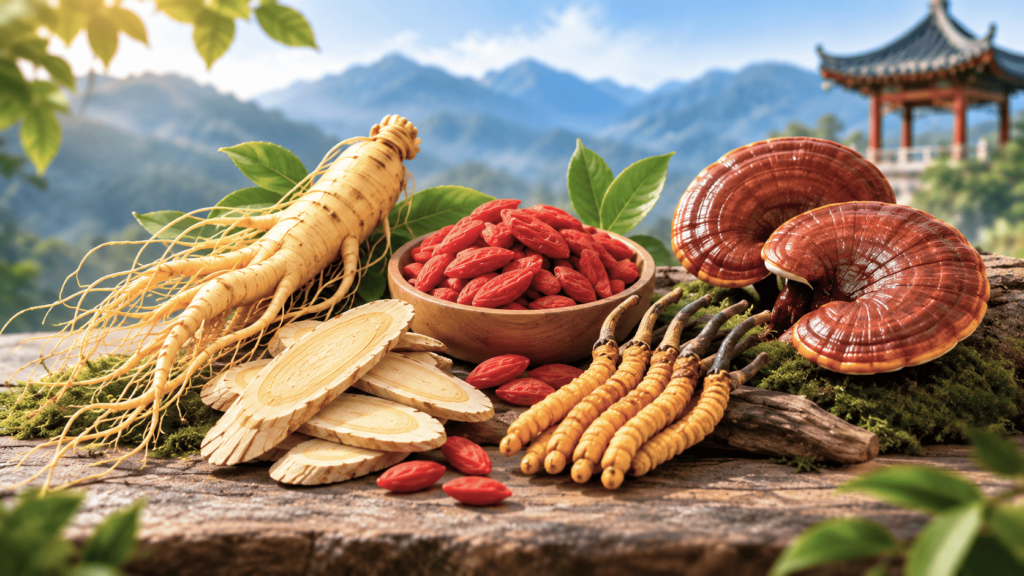
Many men over 50 begin to look beyond the pharmacy shelf when they think about long-term wellbeing. Traditional Chinese Medicine (TCM) is one of the first places they turn, and herbs are usually the first thing they read about.
But what makes these herbs so popular? And how much of their reputation is supported by modern science? Let’s explore five well-known Chinese herbs, their traditional uses, and what research tells us today.
1. Ginseng: The Traditional Vitality Herb
Ginseng is one of the best-known herbs in Chinese medicine. Its root has been used for centuries and is traditionally associated with vitality, strength and restoring Qi, or vital energy.
Interestingly, ginseng’s long history is recognised in Europe too. The European Medicines Agency (EMA) acknowledges its traditional use for symptoms such as tiredness and weakness.
What does the research say?
A 2022 review of 12 clinical trials involving 1,298 participants found encouraging results for ginseng in reducing illness-related fatigue. Although the studies included different types of ginseng, the findings have sparked interest in its potential role in fatigue research, particularly as people grow older. [1]
2. Astragalus: A Traditional Favourite for Balance
Astragalus might not be as familiar as ginseng, but it has an equally long history in Chinese herbal medicine.
Traditionally known as Huang Qi, its root is used in formulas associated with strengthening Qi. In TCM, it’s also linked to Wei Qi, a traditional concept describing the body’s protective energy.
What does the research say?
A 2023 review of 19 human studies involving 1,094 participants found changes in certain immune cell markers and inflammation-related indicators. These findings suggest that astragalus may influence immune responses, although further research is needed to understand what this means for everyday health. [2]
3. Goji Berries: More Than Just a Superfood Trend
You’ve probably seen goji berries sprinkled over breakfast bowls or sold in health food shops. But these small red berries were part of Chinese food culture long before the term superfood became popular.
Known as Gou Qi Zi, goji berries have traditionally been used in soups, teas and herbal preparations. In TCM, they’re associated with the liver, kidneys and eyes.
What does the research say?
A 2021 clinical trial involving 27 adults aged 45–65 found that eating goji berries for 90 days increased certain measures of macular pigment density, a marker associated with eye health. These early findings offer an interesting direction for research into healthy aging, although they do not establish protection against eye conditions. [3]
4. Cordyceps: The Unusual Fungus with a Long History
In TCM, cordyceps have traditionally been associated with the lungs, kidneys and vitality.
Wild Ophiocordyceps sinensis grows on insect larvae in the high-altitude regions of the Tibetan Plateau. Its Chinese name, Dong Chong Xia Cao, translates to “winter worm, summer grass”.
What does the research say?
A 2025 scientific review highlighted promising findings for cordyceps in exercise endurance, with some human studies reporting improvements in how long participants could exercise before exhaustion. While results remain mixed, researchers see potential for further investigation into physical performance and healthy ageing. [4]
5. Reishi: The Mushroom Known for Calm and Balance
Reishi, known as Ling Zhi in Chinese medicine, has been used in traditional herbal preparations for centuries.
Its Chinese name is often translated as “spirit mushroom”. In TCM, reishi is associated with calming Shen, a concept linked to the mind and spirit, as well as supporting Qi.
What does the research say?
A clinical trial involving 88 men over 49 found that a specific reishi extract improved urinary symptom scores after 12 weeks compared with a placebo. However, the study found no significant changes in urine flow or prostate size, making this an interesting early finding rather than a confirmed treatment benefit. [5]
Ancient Traditions, Modern Choices
Traditional Chinese herbs offer an interesting glimpse into how people have approached health and wellbeing for centuries. From familiar ginseng to the unusual cordyceps fungus, each has its own history and place in Chinese medicine.
For men over 50, the key is to stay curious without overlooking the evidence. Herbs may be worth learning about, but they shouldn’t replace the basics of healthy aging: good sleep, regular movement, balanced nutrition and routine health checks.
And before trying something new, a quick conversation with your GP or pharmacist can help you make a safer, more informed decision.

